Studying plastic solar cells at Universitat Autonoma de Barcelona, learning languages at Agora, and exploring our surroundings. Stay tuned for details.
Sant Medir was a farmer living near Sant Cugat in the 4th century CE. The story is that he was planting beans when the Romans approached him. They asked him about a passing bishop they wanted to catch, he told them truthfully that he had seem him, and then the beans shot up, fully grown. The Romans took him, captured the bishop, and killed them both. A longer version of the story is here.
It is traditional to hike to the Sant Medir church, which is where he used to live.
Spring is just starting with lots of trees in bloom and others with their new green leaves.
We did not get to the event in time for the religious ceremony,
and I don't know what this is, but
we did get there in time for the ceremony for people receiving this year's ribbon.
Next up were the dancing giants.
The giant even had his medallion,
just like this one.
They were selling quite a variety, each with a bean.
We also got to see the big heads,
the bastoners,
and the castellers.
The final event was the traditional sardana dance. The orchestra is in the background wearing orange hats.
There are more festivities in Barcelona tonight, but we will pass.
I feel some pangs of guilt for not supporting the arts financially and turning around and paying a lot to tour the stadium of a professional sports team. Parenting has lots of moments like that.
It does look just like a video game!
We saw lots and lots and lots of trophies.
There was a whole room for the basketball team. which was formed 29 years after the futbol team.
I liked seeing all the logos,
some of the old equipment,
and I especially like the collections of pins.
In this room you could listen to some famous play-by-plays and The Décima Song.
It is a little nicer, but this part of the locker room doesn't look so different from my high school.
Of course the tour ends at the gift shop,
but we were able to resist temptation.
Now A. really, really wants to go to a game. For me the tour of the stadium was enough.
The first museum we visited was Reina Sofia, or officially Museo Nacional Centro de Arte Reina Sofía. The building was Madrid's first hospital, but it works well as a museum.
The Calder mobile in the courtyard was moving a bit, which surprised me.
There were plenty of people, but it did not feel crowded.
On the second day we visited The Tyssen, or El Museo de arte Thyssen-Bornemisza. The line was long, but it also did not feel overly crowded once we were inside.
In the old part of the museum with a model of the expansion.
Photography was allowed and I started to photograph paintings I liked, but it was like going to an enormous all-you-can-eat buffet and taking a little bite of everything. It was too much.
Before I finished I was stuffed. But I couldn't stop! I wanted everything. I might have enjoyed the museum more over the course of a few days, or maybe living in Madrid and getting a membership.
Another long line (all around the plaza), this one to get into the royal palace.We were lucky to get in before the doors closed.
We learned our lesson for the last free museum, The Prado, and got there before the free hours began. It is much better to be near the front of a very long line!
They do NOT allow photography, but even if they did I would not have been able to get such nice shots as you can see in this video.
It would be insulting to say we got our money's worth, but I think we did enjoy the museums more since they were free. We felt like we could see only what we wanted and stay only as long as we cared to.
Probably everyone who does a blog about Madrid uses pictures like these, but it is so hard to resist. So here are a few pictures of the regular tourist shots!
It is good to explore new places and learn new things. I don't know what I'll do with the things I learn, but at least I get to explore!
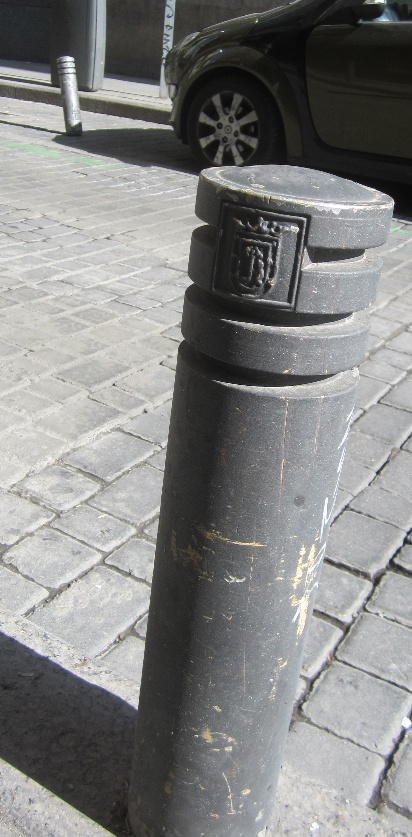
When we arrived in Madrid I noticed the cute animal and tree in the center of the maintenance cover and
just steps away it was also on the trash can.
A. helpfully pointed out that it was also on the parking guides.
We finally got more than a few steps from our place and saw an ad from the city trying to get residents to submit proposals and to increase citizen participation.
The coat of arms was also on the trash cans in Parque de El Retiro.
Unfortunately I didn't know you were supposed to rub the statue for good luck. I'll have to go back.
The bear eating from the strawberry tree has been the symbol for the city since the 13th century. This is what I learned from this site
No one seems to know exactly why the bear and the strawberry tree are the city's icons except that there used to be many bears in the fields around Madrid, and the strawberry tree might actually be representative of the hackberry tree that once was in abundance around the city. Another theory is that following a 13th-century dispute over hunting rights on the land that was owned by the church, an agreement was reached that the church owned the soil, but the people of Madrid owned everything above the ground, namely game. Then, the symbol of Madrid was born -- a Bear (the church's emblem) sniffing a tree. The 20-ton bear statue was constructed in 1967 by sculptor Antonio Navarro Santa Fe and is a popular gathering spot.